Entry is under strain
Global youth outcomes, graduate transitions and junior hiring remain weaker than a healthy first-rung system would suggest.
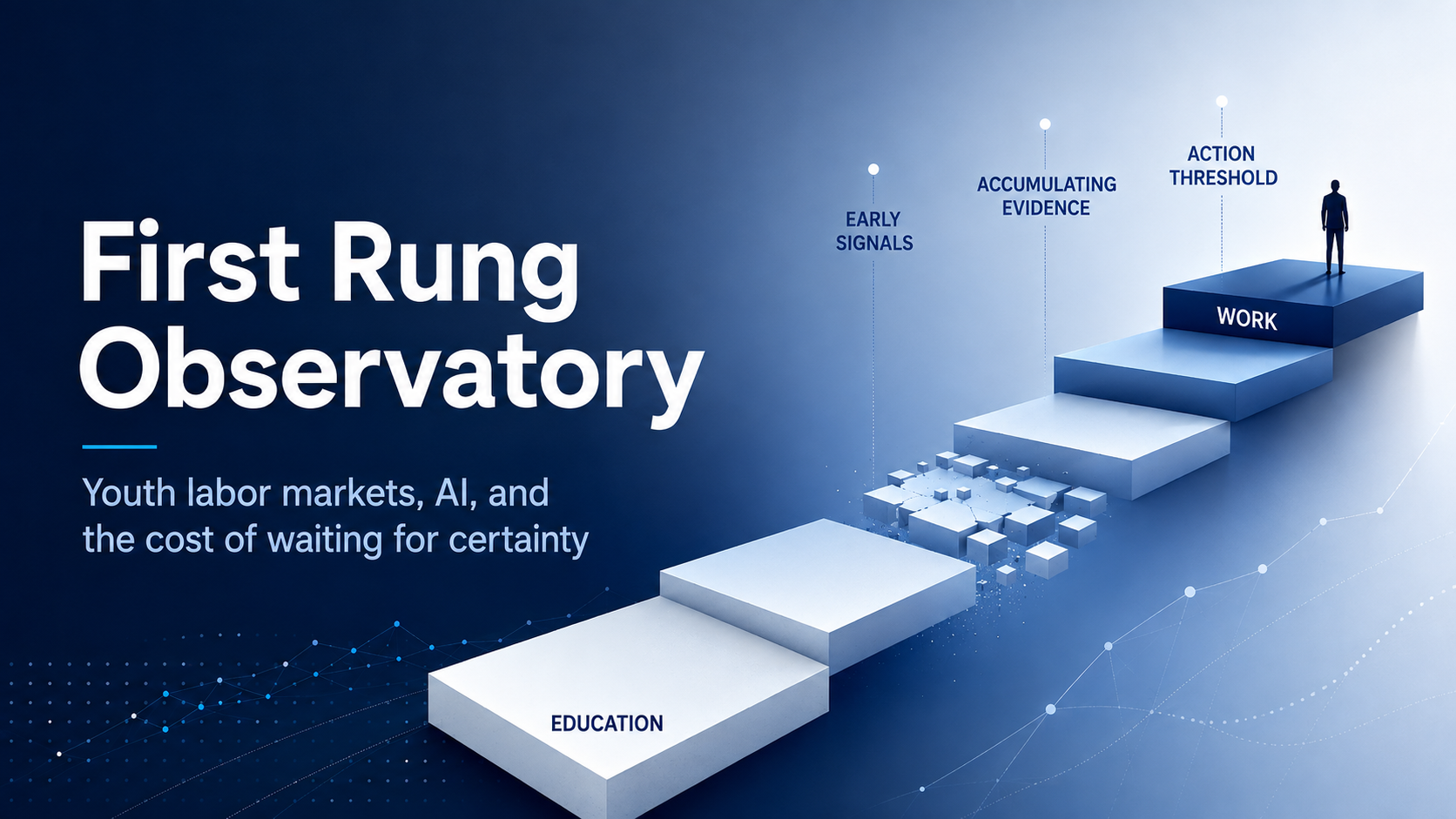
The Observatory tracks how young people enter work, develop competence and progress as AI and workplace practices change. We see multiple, sometimes contradictory signals; we cannot yet establish how much, if any, of the change AI has caused. The purpose is to make uncertainty visible before it becomes an excuse for inaction.
No composite score. Labour-market outcomes, work-organization mechanisms, AI-exposure signals and counter-evidence stay visibly distinct.
This is the original August decision baseline, retained for provenance. The November interpretation below takes account of subsequent, sometimes contradictory evidence.
Global youth outcomes, graduate transitions and junior hiring remain weaker than a healthy first-rung system would suggest.
Remote and hybrid work predate generative AI and can reduce proximity, feedback and the ease with which inexperienced workers are developed.
Age × exposure and substitutability patterns remain suggestive, but working-from-home exposure materially complicates simple AI attribution.
The risk is not only fewer jobs. It may also be fewer opportunities to learn through work, but we do not yet know whether AI is weakening or improving that developmental pathway overall.
Seventeen distinct contributions have been added from an eighteen-item source review, replacing press coverage with original research where possible and retaining counter-evidence. The ledger now has 76 observations, not 76 independent estimates or new datasets.
Frank et al., the New York Fed and the Economic Innovation Group find that exposed occupations were already weakening. A reduction in new hires can reduce employment among 22–25-year-olds simply as people age out of the group, without a targeted wave of layoffs.
These are overlapping critiques using different administrative, vacancy and profile data. Monetary tightening is a rival mechanism, not a proven complete explanation.Frank et al. · Original paper ↗New York Fed · Vacancy test ↗Hosseini Maasoum and Lichtinger and Klein Teeselink find weaker junior hiring at exposed or adopting firms. Yale's October 2026 update finds no clear aggregate labor-market footprint. Anthropic's usage-adjusted analysis also finds no general exposed-worker unemployment rise.
Different populations, adoption proxies, outcomes and designs. Neither positive firm-level associations nor null economy-wide estimates settle the causal question.Hosseini Maasoum & Lichtinger ↗Yale · Updated tracker ↗Emanuel, Harrington and Pallais find more coding feedback when junior engineers are near coworkers, but a short-run output cost to senior mentors. Garicano–Rayo and Ide model possible damage to knowledge transmission when automation changes the junior work–training bargain, even without immediate job losses.
The proximity result is empirical and not AI-specific; career viability and long-run growth pathways are conditional theories, not measured forecasts.Emanuel et al. · Published study ↗Ide · Current working paper ↗Among Northeastern survey respondents saying AI affected their hiring, 26% report hiring fewer juniors and 7% more; others expect junior staff to do higher-level work. PwC also finds more demanding senior-type skills in exposed junior vacancies. Denmark's administrative data find work-task changes without detectable pay or hours effects.
Northeastern uses a weighted nonprobability opinion sample and conditional self-reports. PwC uses advertised requirements. Denmark covers a limited early period. None is a universal AI displacement rate.Northeastern · Primary report ↗Humlum & Vestergaard ↗There is real weakness in young people's transition into work, but no settled estimate of the AI contribution. A lower stock of young workers may reflect weaker inflows rather than layoffs; exposed vacancies may decline even without firms adopting AI; adoption may redesign tasks before employment or pay moves; and removing early tasks may damage, improve or reconfigure development. The evidence argues for measuring these channels separately, not announcing an AI unemployment verdict.
Read the complete classified ledger ↗Evidence discipline: This closing audit adds 17 source observations, not 17 mutually independent causal tests; several draw on LinkedIn, Lightcast, CPS or related exposure mappings. Of 18 supplied candidates, the January 2026 UK government capabilities assessment is documented but not added as another empirical result because its key studies are already represented. All prior records and August 2026 chart data remain intact.
Recruitment, hiring, unemployment, wages, skill advertisements and educational pathways are different indicators. They move at different speeds, cover different populations and sometimes disagree. The Observatory collects these contrasts rather than forcing a single AI story.
US payroll employment grew 165,000 in October, while unemployment for people aged 20–24 was 7.5% against 4.1% nationally. Neither series isolates first-job access or an AI effect.
Different surveys and denominators. A stronger aggregate labor market is a counter-signal to a simple jobs-collapse account.BLS · Primary release ↗With 2019 set at 100, Lightcast finds entry-level vacancies around their baseline while total advertised jobs stand at 127. Health care and IT show very different trajectories.
Advertised vacancies, not realized hires. AI exposure and remote-work suitability overlap; prior weakness predates widespread generative AI.Lightcast · 14 October ↗Among AI-related postings, the junior-to-senior ratio moved from about 1:2.5 in 2022 to 1:4 in the first half of 2026. Yet junior AI postings also grew in absolute number.
AI skill mentions are neither organizational adoption nor overall entry hiring. Experience groups are 0–2 and 5+ years.Lightcast · 19 October ↗In US advertised salaries since 2021, the high- versus low-AI-exposure growth gap is about 17 percentage points for senior postings and 2 points for entry-level postings.
Descriptive salary advertisements, not causal individual wage premiums. Seniority-specific regressions are mostly statistically insignificant.Indeed Hiring Lab ↗ONS estimates 981,000 young people NEET in Q2 2026 and 691,000 UK vacancies in July–September. Milburn identifies persistent weaknesses in pathways from education to employment.
NEET and vacancies measure different populations and dates; the latter was already in the October ledger. Neither establishes AI causation.ONS · Youth release ↗NFER describes essential employment skills; the Pissarides Review stresses organizational choices; Hillman asks whether AI removes tasks through which newcomers used to learn. Direct tests of workplace capability development remain scarce.
Related research and synthesis are not independent confirmations. Skills requirements, demonstrated competence and AI-assisted outputs must be distinguished.Ada Lovelace Institute · 9 November ↗Soft junior hiring could reflect cyclical demand, slow turnover, remote-work effects, automated tasks, higher skill requirements or shifting sector mix. Conversely, AI could improve tutoring, lower barriers to specialized work or generate new opportunities. LinkedIn reports rapid hiring growth for junior AI Engineers while broader hiring remains subdued. The point is to test these rival accounts, not average them into a misleading score.
LinkedIn · Counter-signal ↗Data vintage: This section reflects material available on 10 November 2026. The interactive chart panels below are deliberately unchanged at their August 2026 vintages; the October evidence section is preserved as an earlier research layer. Newer values appear in the evidence ledger, not as unverified extensions of historical chart series.
Four additional publications sharpen the distinction between observed organizational practice and possible future transformation. Their findings pull in different directions, and two are models rather than empirical outcome studies.
Workers reporting automated task allocation are more likely to report access to training and learning than those not reporting it. The same 2026 analysis links algorithmic management, especially monitoring, with higher demands and job strain.
Employee-reported, cross-sectional associations. No identified causal effect; conventional software is included. Neither under-35s nor everyone in these jobs is a first-time entrant.Eurofound · Primary study ↗A 2025 survey of more than 6,000 employers reports that about six in ten managers using algorithmic management perceive better decisions. They also flag accountability, explainability and worker-health concerns.
Manager-reported benefits, not independently verified firm outcomes or young-worker development. Its broad measure of algorithmic management is different from Eurofound's worker survey.OECD · Primary working paper ↗McKinsey's 57% estimate concerns technically automatable US work hours; the DeepMind model shows how improved AI coordination could alter firm organization and wages in ways that are not linear in capability. Neither predicts observed junior employment.
The McKinsey model relies on expert assumptions and AI-assisted activity-to-skill mapping; the DeepMind results are conditional theoretical equilibria. Their appendix and underlying citations are not independent confirmations.McKinsey · Study and appendix ↗Imas, Koh & Legg · Working paper ↗The most useful new empirical result is not a single positive or negative sign. Eurofound finds both training-related advantages and greater pressures associated with algorithmic management. Selection, prior workplace quality and reverse causation are unresolved. Our question remains whether young entrants acquire lasting competence and opportunities to progress. None of these four sources directly measures that outcome, and algorithmic management must not be equated with generative AI adoption.
Inspect the four separately classified records ↗Source discipline: Eurofound (2026) uses employee reports collected in 2024; OECD (2025) surveys managers in six countries; McKinsey (2025) combines vacancy data and assumptions to model potential; Imas, Koh and Legg (2026) provide an economic theory. They are not four matched tests of the same proposition, nor do they add new monthly observations to the August trend charts.
New administrative, payroll, recruitment and firm-level evidence brings the first rung into sharper focus. These are findings from different studies and populations, not one continuous series or a causal verdict on AI.
At Anthropic, the junior share of technical hires fell sharply while the firm expanded and redesigned workflows around agents. Absolute technical hiring still grew.
Single exceptional employer; hiring shares are not counts or causal employment estimates. Wilmers et al. (2026) · Source ↗ADP reports a year-on-year fall of 3.7% for 22–25-year-olds in highly exposed occupations, against a 0.2% rise in the least-exposed group.
Descriptive; related to the existing Stanford payroll stream, not independent confirmation. ADP / Stanford DEL (2026) · Source ↗In ISE’s 2025/26 sample, hiring rose by 4% overall, but by only 0.8% after major outliers; the median employer reported no change.
Structured graduate programs; SMEs and informal entry routes underrepresented. ISE (2026) · Source ↗ONS estimates for July–September put UK vacancies 5.1% below the previous year. This is a wider-market context measure, not a first-rung or AI-specific indicator.
Three-month rolling vacancy estimates, with sampling uncertainty. ONS (2026) · Source ↗Employment for ages 22–24 in the most AI-exposed industry-state groups fell relative to less-exposed groups over ten quarters. The decline was driven largely by weaker hiring.
Association; pre-trends and remote work matter. Tucker (2026) · Source ↗For the most exposed college majors, initial employment probability and earnings fell relative to other majors. Part of the earnings loss reflected movement into lower-paying sectors.
Computing-heavy exposure; technology-sector correction is a rival explanation. Orr, Tucker & Warren (2026) · Source ↗Online job postings fell relatively more at Texas firms whose previous vacancies were more exposed to AI automation, even among businesses present throughout the period.
Job postings measure advertised demand, not hires or AI-caused displacement. Dodini & Smith (2026) · Source ↗Undergraduate enrollment shifted away from more AI-exposed majors in 2024–25. Graduates from those majors also experienced weaker Texas employment and earnings outcomes.
Relative to a 10-point exposure difference; student motivation was not directly measured. Dodini & Smith (2026) · Source ↗Across fourteen measures, occupational AI exposure explained a small fraction of differences in reported firm adoption. Organizational response matters, although the available measures remain imperfect.
Binary adoption, single-unit firms; not an estimate of AI's employment effects. Dey et al. (2026) · Source ↗Worker-grounded TaskNet inventories identify 79 additional tasks across six occupations. More complete descriptions change estimates of what AI could do, before considering whether firms actually reorganize work.
Methodological evidence only; no observation of junior task allocation or employment effects. Wang et al. (2026) · Source ↗Across 101 European occupations, the relationship between AI exposure and 2019–24 job-advertisement growth is weak and statistically insignificant. The most-exposed occupational quintile also grew in employment during 2023–24.
Earlier period, experimental online-vacancy data; neither result tests recent junior hiring directly. JRC, AI and Skills (2026) · Source ↗Bonney and colleagues found that only 2% of US firms reported employment reductions associated with AI in their 2025–26 survey, although broader operational deployment was associated with reductions in regression models. Exposure, use, integration, hiring and job quality remain distinct. The two Dallas Fed articles also use related data and should not be counted as two independent confirmations. The action case may strengthen without settling AI causality.
Bonney et al. (2026) · Source ↗Skills response, also in the ledger: the JRC's separate Studyportals mapping finds AI content in 10.6% of listed English-taught EU master's programs and 7.1% of short-course programs. These are different catalog populations and neither measure establishes the quality or outcomes of the provision.
Research ledger reviewed 28 October 2026. The separate chart panels below retain their August data vintages; October findings on ADP, vacancies and UK graduate recruitment appear above and in the evidence ledger, not as spliced chart values.
The Observatory leads with outcomes closest to labor-market entry and keeps the wider market as context. The hierarchy matters: first-rung outcomes, AI-exposure differentials, then the broader demand benchmark.
Recent-graduate outcomes remained difficult in 2026 Q2.
Comparable shortfall for ages 22–25 in highly AI-exposed occupations widened across the two research vintages.
707k in May–Jul 2026 −2.7% YoY. Broader labor demand has been flattening after a prolonged decline, so this is a benchmark for the recovery test rather than a first-rung measure.
ONS source ↗First-rung outcomes remain weak; the Stanford age × exposure differential widened; the wider UK vacancy market is closer to stabilization. That divergence is worth monitoring, but remote-work exposure remains a material attribution challenge.
Remote and hybrid work predate generative AI and affect many of the same occupations. The evidence now makes work organization both a developmental mechanism and a first-order competing explanation for weaker early-career hiring.
Remote work weakens simple AI attribution but strengthens the first-rung argument. If reduced proximity makes junior workers harder to develop, and AI then removes or redesigns some of the tasks through which they learn, organizations can rationally shift from building capability toward buying experience.
The threshold for proportionate, low-regret action is different from the threshold for causal certainty. We see pressure in several first-rung indicators and plausible mechanisms, alongside recovery signals and substantial competing explanations. No defensible allocation of causation among AI, remote work, hiring cycles or other forces is currently available.
Several entry routes remain strained, but improving US payrolls and specialist hiring demonstrate real differences across markets and roles.
READING · METAI, remote work, recruitment design and employer training choices can weaken or improve how newcomers gain experience. Which pathways dominate is unmeasured.
READING · PLAUSIBLEWeak demand, sector shifts, remote work and AI are entangled. Exposure is a potential, not a measure of deployed technology or a natural causal experiment.
READING · MATERIALLearning opportunities may disappear without a headline layoff. AI could also improve coaching and task feedback; both possibilities need direct measurement.
READING · PLAUSIBLECurrent editorial judgment: the threshold for careful monitoring and protecting entry routes has been crossed; the threshold for estimating how much change AI causes has not.
Entry-level work produces output, but it also produces experienced workers. The central question is whether new role designs preserve or replace that developmental function.
The strategic question is not office versus remote or human versus AI. It is whether work design still produces experienced workers. Obsolete tasks and unnecessary presence can go; their developmental function still has to be replaced.
Each observation retains its evidence stream, geography, AI specificity, comparator, caveat and direct source link. The entries mix outcomes, advertisements, surveys, projections, synthesis and mechanisms; they are not a count of independent confirmations and cannot be folded into an AI score.
The structural interpretation strengthens only if junior and graduate routes remain weak as aggregate hiring stabilizes. Causal confidence in an AI contribution must also survive work-organization controls.
Structural entry-level pressure becomes more plausible.
Strengthens the caseCyclical explanations gain weight and the AI interpretation should narrow.
Weakens the caseRepeated age × exposure gaps that remain after accounting for working-from-home exposure would materially raise causal confidence.
Raises causal confidenceThis is a maintained register, not a closed list. Observations are not independent studies: a single research program or dataset may support several entries, while commentary may synthesize sources already recorded. New sources are added when they improve coverage, comparability, recency or evidentiary quality.
The website is the visible layer. The research asset is the evidence ledger, source register, version history and documented judgment process beneath it. Coverage is selective rather than systematic, and absence of evidence is not evidence of no effect.
Check standing sources for genuinely new evidence on entry access, work organization, AI exposure, employer behavior and early-career capability.
Review new items for population, time period, comparator, version corrections, materiality, methodological quality and reuse of datasets. Do not count a commentary and its cited research as separate confirmations.
Tier 1 official/administrative; Tier 2 large platform or sector data; Tier 3 rigorous research or synthesis.
Every observation retains source, date, comparator, caveat, AI specificity and the reason it matters. Exposure studies are checked explicitly for confounding and co-treatment.
Recovery evidence is not noise. It is required to test whether the entry-level problem persists as the wider market changes.
The site separates observations from inference and recognizes that AI, remote work, sector mix and recruitment cycles interact. Early, reversible protections for entry routes can be justified without assigning causal percentages.
Important: “Action threshold crossed” is an editorial judgment about low-regret monitoring and safeguarding developmental opportunities under uncertainty. It is not a causal estimate and it does not imply that every country, sector or young worker is experiencing the same conditions.